
What is a Registered Herbalist?
Many people have asked me about why I became a Registered Herbalist through the American Herbal Guild (AHG). I wanted to take this opportunity to explain why it was so important to me as a medical professional to work towards and earn this recognition.
Many people have asked me about why I became a Registered Herbalist through the American Herbal Guild (AHG). I wanted to take this opportunity to explain why it was so important to me as a medical professional to work towards and earn this recognition. The AHG offers “Registered Herbalist Membership as a way for herbalists to demonstrate a core level of knowledge and experience in herbal practice that establishes a meaningful standard of competency for themselves, their communities, and other health professionals and institutions. For those who welcome review by their peers as confirmation of their clinical skills, the designation ‘Registered Herbalist’ establishes a recognized level of expertise and commitment to the practice of herbalism.”
My ultimate goal as a veterinarian and herbalist, is to have every medical practitioner integrating all forms of medicine together to create the best approach to health. I spent 4 years in undergrad, 5 years in vet school, and now have over 3000 hours of formal herbal education. This is important because the more professionals recognize the benefit of herbal medicine, the healthier our pets and we will be.
Below I share part of my application essay with you, as I hope to spread the itch to learn more about herbs.
I have had other veterinarians question me on my post graduate degrees, where I obtained this knowledge. Sometimes because they themselves are interested and sometimes because they are questioning me and the validity of the holistic work I do. Becoming a Registered Herbalist would further give a voice to veterinarians using herbal medicine and inspire others. My vision is that every practice will integrate in herbal medicine in the future. Holistic veterinary medicine (alternative and complementary) is growing as a field. I think it is important that veterinarians understand that herbal medicine is not something that you do an internet search on to find an herb to use. That studying herbal medicine to lean not just about the active constituents, but also the traditions, the plants themselves, about our relationship to the plants and how it is a medicine for all. I have numerous students seeing practice with me, from vet school bound college students to vet students. I love being able to show them how valuable herbal medicine is from the traditions to the modern research. As a health professional, I get questions from my clients on my training and where they can find someone like me, an integrative medical practitioner. By becoming a Registered Herbalist, I am able to take that next step to inspire others to use herbal medicine as well as give me more opportunities to teach and reach my goal of getting phytotherapy into every vet practice.

What is Burdock Root?
I went to my local health food market the other day, and to my surprise found burdock root! It is not something you will find in your local grocery store, though you will most likely find it in an asian market. Burdock root is a gentle acting medicinal plant used in Europe, Asia and the Americas. I thought it would be fun to explore the benefits of burdock.
I went to my local health food market the other day, and to my surprise found burdock root! It is not something you will find in your local grocery store, though you will most likely find it in an asian market. Burdock root is a gentle acting medicinal plant used in Europe, Asia and the Americas. I thought it would be fun to explore the benefits of burdock.
Burdock (Articum lappa) is an incredible herb. I use it almost daily for my patients in the form of tinctures or herbal powder. As a medicinal herb it is cooling in nature. It is used for skin problems. It improves digestion. Other uses of burdock root that has been reported in the literature include treating chronic diseases such as cancers, diabetes and AIDS. However, it is also essential to be aware of the side effects of burdock including contact dermatitis and other allergic/inflammatory responses that might be evoked by burdock.
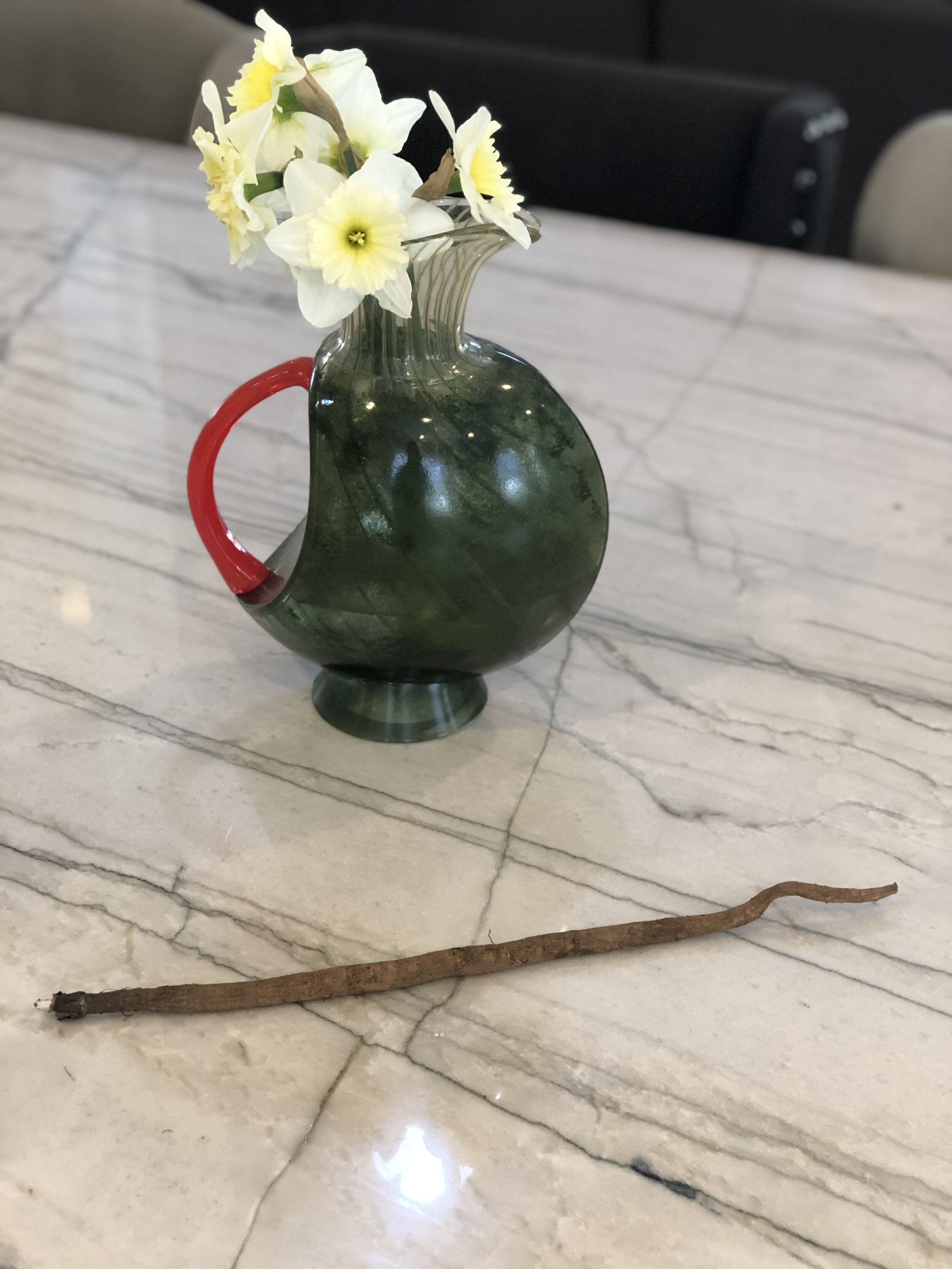
one burdock root on my counter with the daffodils I picked from my yard
Now that I have this medicinal root in my kitchen, I have to decide how to prepare it. To be honest, I have never cooked with burdock. So I did what everyone else does when they don’t know how to cook something. I looked it up and found what seems to be a simple recipe I found on spruceeats.com.
Ingredients
1/2 lb gobo (burdock root)
1/4 lb carrot (peeled and cut into short and thin strips)
1 1/2 tbsp mirin
1 tbsp sugar
1/2 tbsp sake
1 tbsp soy sauce
1 tsp sesame seeds
2 tbsp vegetable oil
Steps to Make It
Peel the gobo’s skin with a peeler (the traditional method is to scrape the skin off with the back of kitchen knife - Sasagaki, between shaved and sliced). Then diagonally slice thin strips so that each piece is about 2-inches in length. Then collect some of the slices and cut into thin matchbox strips.
Soak the gobo strips in water for a while and drain well. You can add a drop of vinegar to the water if desired. Change the water several times until it is clean. Leave the gobo in the water until you are ready to cook.
Cut the carrots into matchbox strips.
Heat vegetable oil in a frying pan, and fry gobo for a couple of minutes.
Add carrot strips to the pan and stir-fry them.
Add sake, mirin, and sugar and stir-fry until the liquid is gone.
Season with soy sauce and stir-fry well.
Turn off the heat.
Sprinkle sesame seeds.
Enjoy!
Obviously don’t feed this recipe to your pet as it contains alcohol.
I asked a fellow holistic vet and herbalist Dr. Connie DiNatale how she prefers to prepare her burdock root. She recommends making pickled burdock t for high blood pressure and head aches, as is used in Japanese traditional medicine. Cooking is a fun way for us to get to know our food that is medicine. If you would like to learn more about how burdock helps, us as well as our pets, let me know in the comments section below. And remember as always, these statements do not replace the medical advise of your doctor or veterinarian.
FDA Disclaimer: The statements on this website have not been evaluated by the Food and Drug Administration. The products presented on this website are not intended to diagnose, treat, cure, or prevent any disease.